Keynotes
Joanne Atlee – Research Track Keynote I

Title: Living with Feature Interactions
The slides to the keynote talk can be found here.
Video can be found here.
Abstract:
Feature-oriented software development enables rapid software creation and evolution, through incremental and parallel feature development or through product line engineering. However, in practice, features are often not separate concerns. They behave differently in the presence of other features, and they sometimes interfere with each other in surprising ways.
This talk will explore challenges in feature interactions and their resolutions. Resolution strategies can tackle large classes of interactions, but are imperfect and incomplete, leading to research opportunities in software architecture, composition semantics, and verification.
Biography:
Dr. Joanne Atlee (P.Eng) is a Professor in the David R. Cheriton School of Computer Science at the University of Waterloo, where she was the founding Director of Women in Computer Science and the founding Director for the Software Engineering program. She has been recognized as an ACM Distinguished Scientist for her work on software requirements modelling and analysis. Much of her work focuses on detecting and resolving feature interactions — unexpected and emergent behaviours among software features. She regularly collaborates with industrial partners who work on safety-critical software, such as telecommunications and automotive software.
She is the General Chair for the 41st International Conference on Software Engineering (ICSE’19) and served as Program Co-Chair for the 31st International Conference on Software Engineering (ICSE’09) and Program Chair for the 13th IEEE Requirements Engineering Conference (RE’05). She served on the ACM SIGSOFT Executive Committee as an at-large member and is a member of the International Federation for Information Processing (IFIP) Working Group 2.9 on Software Requirements Engineering. She is a co-author with Shari Lawrence Pfleeger on their textbook “Software Engineering: Theory and Practice”.
Marta Kwiatkowska – Research Track Keynote II

Title: Safety and Robustness for Deep Learning with Provable Guarantees
The slides to the keynote talk can be found here.
Video can be found here.
Abstract:
Computing systems are becoming ever more complex, with decisions increasingly often based on deep learning components. A wide variety of applications are being developed, many of them safety-critical, such as self-driving cars and medical diagnosis. Since deep learning is unstable with respect to adversarial perturbations, there is a need for rigorous software development methodologies that encompass machine learning components. This lecture will describe progress with developing automated verification and testing techniques for deep neural networks to ensure safety and robustness of their decisions with respect to input perturbations. The techniques exploit Lipschitz continuity of the networks and aim to approximate, for a given set of inputs, the reachable set of network outputs in terms of lower and upper bounds, in anytime manner, with provable guarantees. We develop novel algorithms based on feature-guided search, games, global optimisation and Bayesian methods, and evaluate them on state-of-the-art networks. The lecture will conclude with an overview of the challenges in this field.
Biography:
Marta Kwiatkowska is Professor of Computing Systems and Fellow of Trinity College, University of Oxford. Prior to this she was Professor in the School of Computer Science at the University of Birmingham, Lecturer at the University of Leicester and Assistant Professor at the Jagiellonian University in Cracow, Poland. Kwiatkowska has made fundamental contributions to the theory and practice of model checking for probabilistic systems, focusing on automated techniques for verification and synthesis from quantitative specifications. She led the development of the PRISM model checker (www.prismmodelchecker.org), the leading software tool in the area and winner of the HVC Award 2016. Probabilistic model checking has been adopted in diverse fields, including distributed computing, wireless networks, security, robotics, healthcare, systems biology, DNA computing and nanotechnology, with genuine flaws found and corrected in real-world protocols. Kwiatkowska is the first female winner of the Royal Society Milner Award and was awarded an honorary doctorate from KTH Royal Institute of Technology in Stockholm in 2014. She is the winner of two ERC Advanced Grants VERIWARE and FUN2MODEL, and is a coinvestigator of the EPSRC Programme Grant on Mobile Autonomy. Kwiatkowska is a Fellow of ACM and Member of Academia Europea.
Audris Mockus – Industry Track Keynote
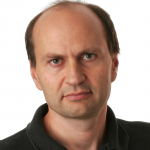
Title: Insights from Open Source Software Supply Chains
The slides to the keynote talk can be found here.
Video can be found here.
Abstract:
Open Source Software (OSS) forms an infrastructure on which numerous (often critical) software applications are based. Substantial research was done to investigate central projects such as Linux kernel but we have only a limited understanding of how the periphery of the larger OSS ecosystem is interconnected through technical dependencies, code sharing, and knowledge flows. We aim to close this gap by a) creating a nearly complete and rapidly updateable collection of version control data for FLOSS projects; b) by cleaning, correcting, and augmenting the data to measure several types of dependencies among code, developers, and projects; c) by creating models that rely on the resulting supply chains to investigate structural and dynamic properties of the entire OSS. The current implementation is capable of being updated each month, occupies over 300Tb of disk space with 1.5B commits and 12B git objects. Highly accurate algorithms to correct identity data and extract dependencies from the source code are used to characterize the current structure of OSS and the way it has evolved. In particular, models of technology spread demonstrate the implicit factors developers use when choosing software components. We expect the resulting research platform will both spur investigations on how the huge periphery in OSS both sustains and is sustained by the central OSS projects and, as a result, will increase resiliency and effectiveness of the OSS.
Biography:
Audris Mockus received the BS and MS degrees in applied mathematics from the Moscow Institute of Physics and Technology in 1988, the MS degree in 1991 and the PhD degree in statistics from Carnegie Mellon University in 1994. He is interested in recovering information and creating models of reality from big operational data. His latest interest concern models of the entire open source software ecosystem based on version control data and anthropological phenomena hidden in large image collections. He is the Ericsson-Harlan D. Mills Chair Professor in the Department of Electrical Engineering and Computer Science of the University of Tennessee. Previously he worked at Avaya Research and AT&T and Lucent Bell Labs.
Keynotes
Joanne M. Atlee
(University of Waterloo, Canada)
 Article Search
Marta Kwiatkowska
(University of Oxford, UK)
Article Search
Audris Mockus
(University of Tennessee, USA)
Article Search